Treatment of Water Exposed to Harmful Wildfire-Related Contaminants
Wildfires are posing a growing threat to drinking water by introducing harmful materials from partially combusted vegetation, known as pyrogenic organic matter, into water supplies. Fire-altered organic material can form cancer-causing disinfection products and its chemical characteristics make it challenging for treatment plants to remove compared to organic matter normally found in rivers and reservoirs. We will investigate how these wildfire-derived materials respond to treatment so water systems can better protect community drinking water as large, severe wildfires become more frequent.
2026 Student outcomes
Students will engage in field sample preparation collection, experimental design, data analysis, and computer modeling of experimental data using statistical analysis software (e.g., R). The primary water treatment technologies tested in the lab include coagulation and activated carbon adsorption as well as disinfection to simulate disinfection byproduct formation in drinking water distribution systems.
This work is supported by a 2026 Gonzaga Research Opportunity.
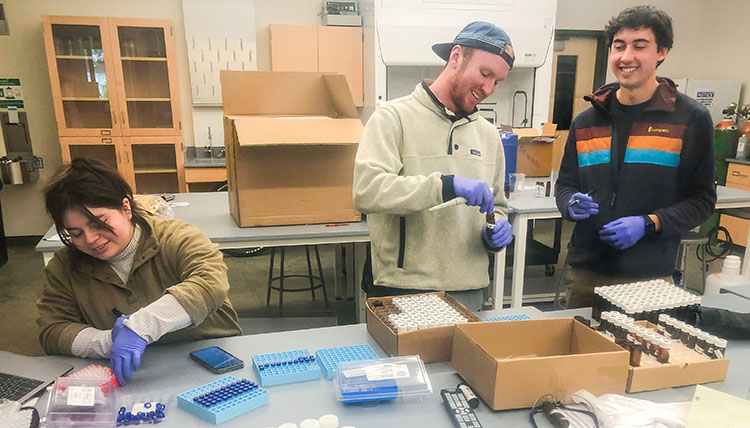
Gonzaga civil engineering undergraduates have worked with Dr. Shimabuku on developing biochar, a low-cost and sustainable alternative to activated carbon, to use in drinking water filters to remove per/poly-fluorinated alkyl substances (PFAS) often referred to as “Forever Chemicals”.
A goal of the project was to determine how biochar production conditions, like peak temperature and heating duration, would influence the performance of biochar.
A comparison of how biochar is produced by a manufacturer based out of Spokane County versus at the Gonzaga lab is shown. Students that visited this facility learned what the range of production conditions this biochar manufacturer can achieve, which was used to inform the production conditions they tested in the lab.
Working with Dr. Shimabuku, Gonzaga undergraduates are also studying the effects of wildfires on drinking water as part of a 5-year USDA Forest Service Grant. Students are working to treat drinking water sources impacted by a wildfire with activated carbon that could remove organic contaminants. The test is being performed with a jar test apparatus that can precisely simulate mixing conditions achieved in full-scale drinking water treatment plants.
Undergraduates in the Environmental Engineering lab have had the opportunity to solve real-world environmental engineering problems. In addition to awards mentioned, four Gonzaga undergraduates have been co-authors on a peer-reviewed publication with Dr. Shimabuku.
This research takes place in the Environmental Engineering Research Lab.